


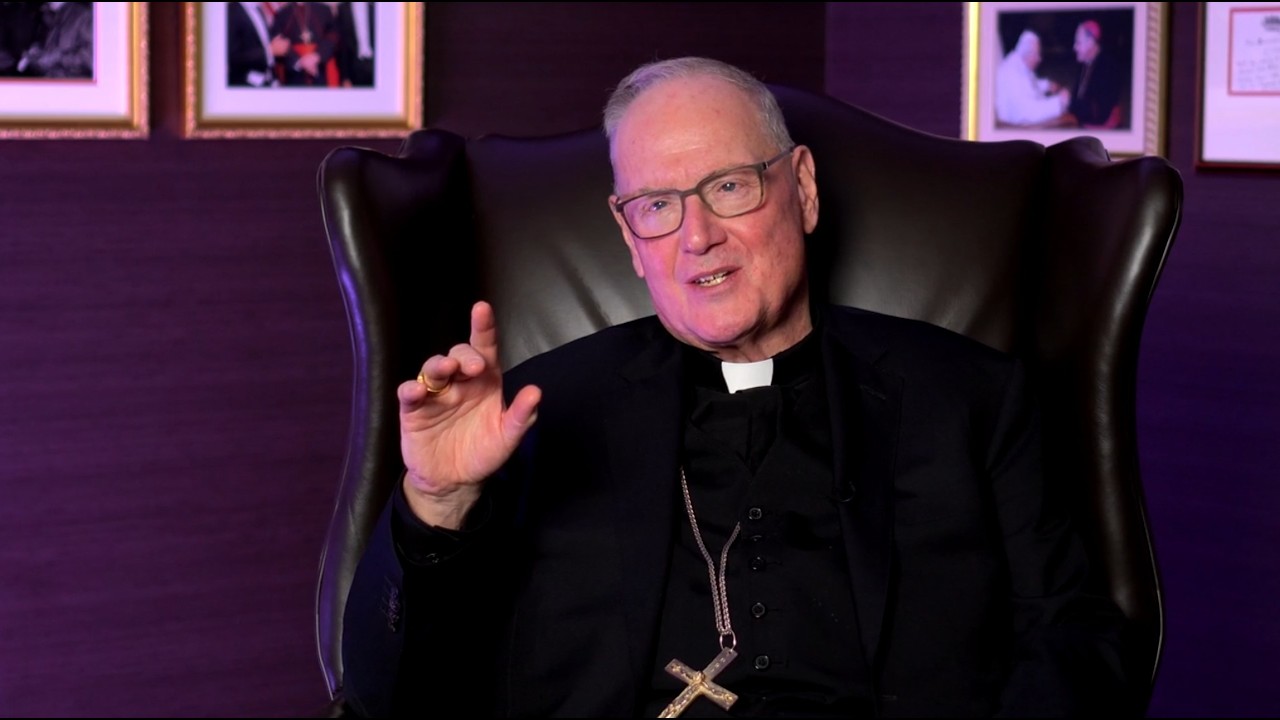





Timothy Dolan reflects on the life and legacy of his father, sharing powerful stories from a childhood shaped by love, discipline, and sacrifice. He speaks about his father’s difficult upbringing during the Great Depression, his service in some of the most intense naval battles of World War II, and the quiet strength he carried throughout his life. Through personal family memories, moments of humor, and deeply meaningful lessons about duty, faith, and support, Cardinal Dolan reveals how his father’s example shaped his own calling to the priesthood and his understanding of what it means to put family first.
Check out our website! www.luckyones.TV
Follow us!
@luckyonestv
On Instagram: https://www.instagram.com/luckyonestv/
On Facebook: https://www.facebook.com/LuckyOnesTV/
On X: https://twitter.com/luckyonestv/
Read the Transcript:
A Reflection on a Great Father
When you think of who had an impact on your life, sometimes you’re tempted to think of these dramatic, towering, legendary figures, and there would be some. But you know what? I think most people are like myself, shaped more or less through the simple people who were there, especially when you were growing up. My name is Timothy and I’m one of the lucky ones. My dear dad, Robert Matthew Dolan, he was a great dad. And do you know how lucky I am to be able to say I had a great dad? I’m a priest, and I work with a lot of people who aren’t able to speak about a happy family life.
He had a tough life. He was born in ’25 and he was raised during the Depression. I remember once he took my sister and me—I was the first of five, but it was just Deb and I; I think I was five and she was three—and he took us through Maplewood, Missouri and showed us all the different places where they lived. I kept asking, “Dad, why did you live in so many houses?” He kind of just said, “Well, those are tough times.” A lot of times they were unable to pay the rent, so they had to move someplace cheaper.
Then when he turned 18, in 1943, he immediately enlisted into the Second World War in the Navy. I didn’t know this until later, but he was in some of the roughest Pacific Naval battles around. I mean, I’d be watching movies about Guadalcanal, Pearl Harbor, and all these Pacific Islands where men were massacred and where the war looked at its lowest. My dad never said a thing. Then one day in the hall closet, I found his diary, and he was at all of ’em. He never bragged about it; he just sort of shrugged and said, “Well, that was the duty we had.”
But I can tell in retrospect it kinda left him scarred. For one, he had a physical scar—he had lost the hearing in his right ear. He said he was going from one place to another, his earplug fell out, and he lost his hearing. But I also know there would be moments when I could just see him looking off into the distance. There would be moments when I thought, I wonder what he’s thinking about, and I know that he must have been reliving some of the horrors of the war about which he never spoke.
Duty and Putting Family First
Duty, responsibility, reliability—these are just the things that generation did. For example, I had just gone to the bathroom. We had one lousy bathroom in our house. He said, “Kid, come in here. You just go potty?” “Yeah.” “Did you flush the toilet?” “Yeah.” He said, “What’s missing?” I said, “What do you mean?” He said, “You used the last of the toilet paper. Never ever leave the bathroom without putting new toilet paper on there.” I don’t know if you could get any earthier than that, but is that not a sense of duty?
He fell in love with my mom, Shirley, when he got back from the war, and they were married in 1949. They had a magnificent marriage. I can remember when dad died, at the wake, all these people were coming up. One of them said to me, “You know what? Your mom and dad were still like two teenagers in love.” Dad’s whole life was his wife and his kids. That was his life. God and his faith were the most important things to him, but that was shown in his singular love and loyalty for his family.
When dad would have his two weeks of vacation in the summer, we couldn’t go anywhere. Again, we didn’t have a lot of money. We were comfortable, and we could not sense that we were missing anything. He loved his neighbors, he loved his own extended family, and he loved the parish that we were in. He was a good Catholic. We’d be at Mass every Sunday and he would lead us in, but then he would step aside so we would all go in before him, getting in at the end himself. At the time for Holy Communion, he would get out of the pew and let us all go before him. He kind of always put us first.
Those were very tangible ways. I often have reminded and teased my brothers and sisters about the ketchup bottle. My dad loved ketchup; he put ketchup on everything. It drove my mom crazy ’cause she was a darn good cook. But he put ketchup on everything except on Thursday nights. He would get paid on Friday, which is when mom would shop, so Thursday night was leftovers—and that’s what you really wanna put ketchup on, right? But if the ketchup bottle was low when it was passed to him, dad would just pass it on. It is the tiniest thing I can remember, but it showed that he thought, I want that ketchup, but so do my wife and kids, and they get it before me.
Life in St. Louis
My dad worked hard. He had a tough job. When he’d come home—we lived in St. Louis, and in the summertime, you can barely breathe it’s so hot and humid—he would arrive in his beat-up car. He would get out, and I could see his shirt sticking to him with perspiration. My brothers Bob, Pat, and I would be out waiting for him with our baseballs and gloves. We’d say, “Hey dad, can we play catch?” Dad would do it for five or 10 minutes. He’d just play catch with us, and then he’d go sit with my mom for an hour at the kitchen table and talk. We were never told to leave him alone, but we kids sensed, Ah, this is their sacred time together. How could a life of love and fidelity between a man and a woman raising five kids under pretty tough circumstances have persevered if they didn’t have that?
Rarely would we hear them arguing. That was a flaw that dad had, which I have inherited in retrospect: wanting to avoid tension. He passed that on to me, which is not good, because things are usually better when they are aired out. But he and mom would have that time together, and then all of a sudden they’d say, “Come on in kids, dinner’s ready.” We would eat right at six o’clock, just as the church bells were ringing.
I remember a story about his own mother. He was sitting at the table with her and he was kind of down in the dumps. He said, “Mom, I got my fourth kid now, and I don’t have a job. I’m kinda worried. I got two weeks of pay coming and that’s about it.” I can remember his mom saying, “Bobby, we’ve got through worse before.” This was a woman whose own mother would’ve experienced the famine in Ireland, and I think he inherited that trust that things were gonna work out.
He also loved horseshoes and he liked being underrated. He loved it, for instance, if we were at a picnic and people didn’t know him. He’d be watching a horseshoe game and say, “Well, how’s that work? How do you keep score and all?” Sooner or later they’d be nudging each other, thinking, Let’s take this guy for a ride, and they’d ask, “Come on up, you wanna get into a game? 50 cents a game or something.” He mopped up! You just saw sparks coming right off that peg ’cause he was a great horseshoe player. Needless to say, they didn’t ask him back.
The Path to the Priesthood
He knew for a while that I was very interested in the priesthood. In eighth grade he said, “Well, Tim, your mom and I wondered where you wanna go to high school.” I said, “Well, Dad, I think I wanna be a priest and I think I can go to the high school seminary.” He told me, “We’d be happy to have a son a priest, but we’d also be happy to have a son who’s a garbage collector, and we’re gonna love you whatever you do. So don’t you ever feel pressure thinking that you gotta be a priest because of us.”
It takes 12 long years to prepare for the priesthood. Every summer he’d ask, “Are you gonna go back to the seminary?” I’d say, “Yeah, Dad, I think I am.” He’d ask, “You’re happy?” I’d say, “Yeah.” He’d say, “Well, I think you’ll be a great priest, but once again, if you ever wanna leave the seminary, your mom and I are gonna be just as happy with whatever you decide to do.” There was great freedom and great liberation there. No coercion.
Later, the Cardinal in St. Louis asked me to go to Rome for my last four years of study. I said, “I don’t know, I don’t think I should go. I don’t think we can afford that, and I don’t know if I wanna be away from home.” My dad said, “Well, Tim, we think you should go.” When I finally told him I was going, I saw him tear up. It dawned on him that I was gonna be gone for four years, and it moved me very much to realize, My God, the old man’s gonna miss me. In my last year in Rome, it was tradition that your mom and dad would buy you your chalice. They said they wanted to give it to me, and I told them I could have one custom-made in Rome for $300. They sent the check over, but the check bounced. They didn’t have enough in the account. They probably did when they mailed it, but with 10 days over and 10 days back, by the time it cleared, the funds weren’t there. To me, knowing that my mom and dad sacrificed so much to pay for the chalice I use to say Mass that the check actually bounced—I’m kind of proud of that. It means a lot to me.
Ordination and a Sudden Loss
I can remember him beaming on the day I was ordained a priest: June 19th, 1976. The next day was Father’s Day. He gave a little toast and said, “I wanna toast my son because he’s given me a high honor. To think that a father is gonna be able to call his son ‘Father’ is one of the greatest gifts I can imagine.” You can contemplate how I would’ve beamed at that, coming from this man I admired so immensely.
A couple of weeks later, the pastor of my first parish called me and said, “Tim, we just got a note that you still owe tuition from the seminary.” I didn’t know how that could be because I worked every summer and gave Mom and Dad the money to pay for it. I thought it was a mistake, so I went home and asked about it. I could see my dad was crushed because it was true. He said, “Tim, you gave us the money and we used most of it for the tuition, but we kind of needed some of it.” The practice of the archdiocese was to deduct $10 from my salary to pay it off. I said, “Well, that’s okay, 10 bucks.” He said, “No, we’ll pay that 10 bucks.” I told him, “The hell you will.”
He died just nine months after I was ordained a priest, but at least he was there with me for the first innings. Dad dropped dead at work at age 51 from a massive heart attack. Mom and I drove over to St. Joseph’s Hospital in St. Charles, Missouri, and when we arrived, we were told, “Your father didn’t make it.” You know what my mom said? She said, “And today was gonna be his last day of work before his two weeks of vacation.” I thought, Boy, Dad, you had a lot of tough luck in life. You even died before you got to have your vacation. One thing I worried about after that was that I was probably gonna die young too. His own dad had passed away at 56. So I thought, Well Dolan, you better savor every day, you ain’t gonna be around long. Well, I’ve outlived them both now, but you kind of learn to savor things a little more, don’t you?
There were many, many things about my dad I didn’t know and never had the chance to ask him. I’m just glad his name is engraved at the bottom of my chalice. Later, his sister, my Aunt Fran, asked me, “Do you know your father wanted to be a priest?” I said, “Aunt Fran, I never knew that.” She told me that he had wanted to be one, and my grandpa had taken him up to see Father Ryan at the parish. My grandpa said, “Father, I don’t know if we can afford that tuition.” Father Ryan replied, “I will take care of that.” But the next Sunday after Mass, some windbag blowhard came up to my grandpa and started bragging loudly, “Hey, I’m gonna take care of your kid’s tuition at the seminary!” My grandpa looked at my dad and said, “Bobby, you ain’t going to the seminary. I don’t need this guy’s charity.”
So he didn’t become a priest. When my aunt told me that, I said, “Well, you know what? I’m kind of glad he didn’t, ’cause I couldn’t have become one. In fact, I couldn’t have even become a human being if it weren’t for my father.” For me, when Jesus revealed God as our Father, I thought, Ah, that’s a good image for me, because I had a darn good one. I’m eager to meet him again in heaven.
#CardinalTimothyDolan #TimothyDolanInterview #CardinalDolan #CatholicCardinalInterview #ArchbishopOfNewYork #CatholicChurchLeadership #ReligiousInterview #FaithLeaderInterview #WorldWar2veteran #WWIInavalbattles #WWIIveteranstory #MilitaryServiceWWII #Vadican #Pope #LifeLessons #LivingFully #Gratitude #TheLuckyOnes #tlo #BehindTheScenes #Inspiration #Grief #celebratelife #celebratelove #celebrationoflife #celebration #love #memories #memorieslastforever #community #carryyouinmyheart #lovedandlost #griefislove #griefjourney #inspiration #shareyourstory #lifeaffirming #remembrance #tribute #inmemoriam #memorial
Related videos
 Watch LaterAdded
 Watch LaterAdded
 Watch LaterAdded
 Watch LaterAdded
 Watch LaterAdded
 Watch LaterAdded