


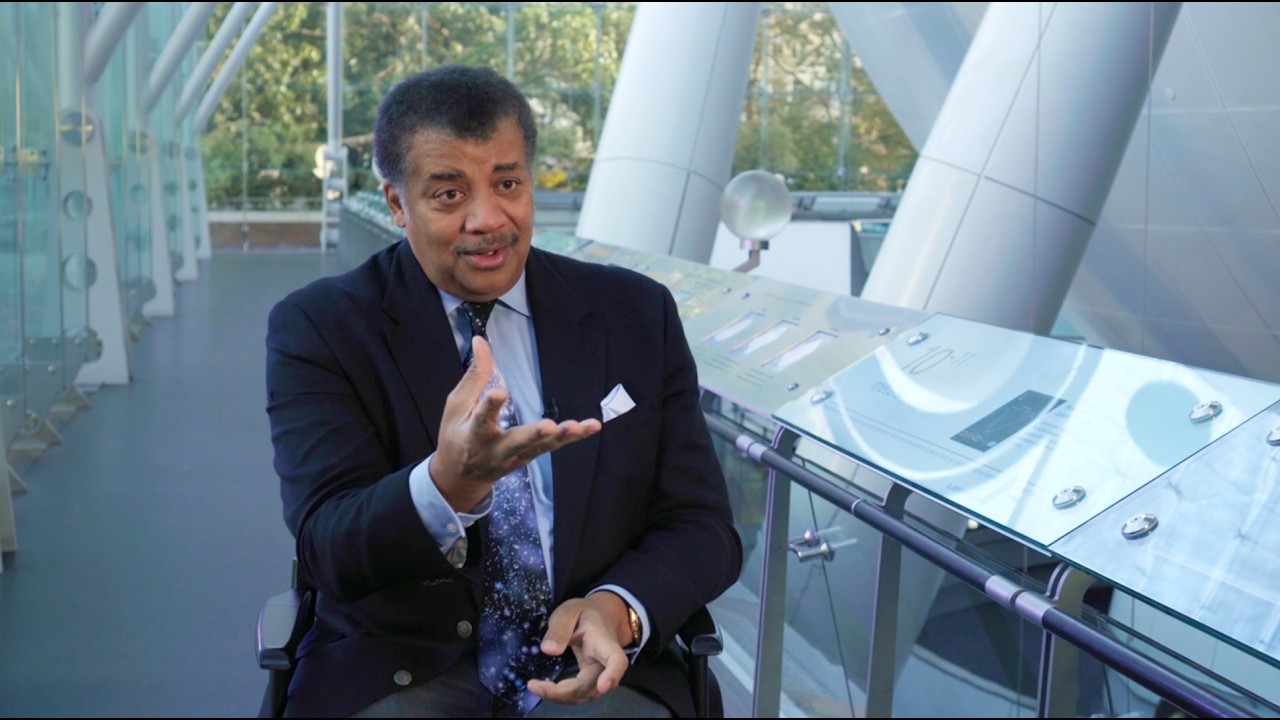





Neil deGrasse Tyson reflects on the mentors, parents, and experiences that shaped his life. From Carl Sagan’s guidance to his parents’ early lessons in curiosity, social skills, and the human condition, Neil shares how these influences and hard work helped him build a career dedicated to science, education, and making a meaningful impact on humanity.
TRANSCRIPT:
Everybody’s looking up. Is that a planet up there? Yes. But you know what else it is? It’s a world. When you call it a world, that changes it in you. It’s like, I want to know what that’s like. I want to imagine myself there. Hi, I am Neil deGrasse Tyson. I’m an astrophysicist. After a first visit to the Hayden Planetarium, I was hooked.
People are complicated, weird individuals, but if they have a specific talent that I value and that I respect, then I said to myself, “I want to be that.” And so I assembled my, if I call it a role model, I assembled my role model a la carte stapling together bits and pieces of people who have talents and abilities and and interests that I wanted to emulate. And so it is a Frankenstein role model and no single person is overrepresented in it.
I think there are a lot of people in my life who I’m lucky to know, perhaps the most known among those in this list would of course be Carl Sagan. Carl Sagan’s influence on me had nothing to do with my passion for the universe. That was well established long before I knew he even existed. The primary impact he had on me was recognizing that someone of his stature, someone of his fame, would spend any time at all with me, a 17-year-old kid from the Bronx who he didn’t know at all. The only thing that mattered to him was that I had ambitions that overlapped with his profession.
My first encounter with him was in high school when he invited me to visit him at Cornell in his office after I had applied to Cornell and had not yet decided whether I wanted to attend. Someone must have tipped him off that there’s this kid from the Bronx, ’cause he’s also from the city. I think he was from Brooklyn. Someone must have tipped him off that there was a kid applying whose application to college was just dripping with the universe.
Went up to Cornell, he met me in front of the offices. He gave me a tour, did a no look reach. I’d never forget this, behind his desk, and pulled out a book that he wrote. I thought that’s pretty cool. I said to myself that day, on my way back to New York from Ithaca, like five and a half hour bus ride, I thought to myself:
“If I’m ever as remotely famous as Carl Sagan, I will treat the next generation of students the way he treated me.”
I hold students with ambition under very high regard because of that first encounter with Carl Sagan. Many people misinterpret that story as Carl Sagan having been a lifelong mentor of mine. That was not the case. We were probably in each other’s company no more than four times. Never socialized with him, never went out to dinner, never had drinks. But that doesn’t matter. Duration of human contact is not as important as the impact of any one occasion that you might have.
If I’m lucky in this world, here’s why. Because you don’t get to choose your parents. Both my parents cared about education. My brother, my sister, and I were dragged around by my parents to the cultural institutions of New York City. Their art museums and science museums, and natural history museums, and the planetarium, and baseball games, the opera, plays, without realizing at the time that they were purposefully exposing the three of us to interesting things talented adults do to help us discover our North Star.
I, after a first visit to the Hayden Planetarium, I was hooked from day one. I was nine years old. I go in, the lights dim, the stars come out, and of course, I thought it was a hoax. There aren’t that many stars in the night sky. What are you doing? I’ve seen the night sky from the Bronx. There’s like five stars. That’s it. It was quite the force operating on my emotions.
Here’s another thing, my parents had dinner parties all the time, so I was socialized from very early. I didn’t realize the value of being socialized until much later in life because throughout school, I have my report cards and one day I’m gonna publish them. That said less social involvement and more academic diligence is in order. All of my social energies were considered bad in the classroom and in school, all of them. One teacher complained that I laughed too loudly. My parents did not come back and say, “Neil, you need to change so that they will write nice things about you on your report card,” that’s not how that unfolded.
Point is, as an adult, building this place here, fundraising, speaking to donors, speaking to politicians, speaking to administrators, that takes social skills. And I had well-developed social skills going into adulthood that I credit my parents. What mattered to me for both my parents was their kindness they expressed to others, to those who were in greater need than themselves. They were humanists in that regard. And as an astrophysicist, that kept me anchored. I’d be floating in space were it not for the luck of me being born into parents who cared about the human condition as deeply as they did, and they took care of old people. My mother became a gerontologist, for goodness sake, worked in a nursing home.
We don’t get to choose our parents. So the fact that I’m born into that family, stable household, educated parents, that’s luck. And I think daily about people who were born broken families, violence in the families, addictions. And I say to myself, “How much greater this world would be for want of opportunity for those who are otherwise born into circumstances that cannot realize their ambitions?” If I’m lucky, it’s for that reason alone.
As a kid, once you go to the space show here, is there more or to have to wait for another space show? The institution also offered classes and lectures. I took advantage of all of it. And while there, there was an educator, his name is Fred Hess. You don’t know him because he didn’t have a hit TV show or bestselling books, but he could tell a story like, oh my gosh. He told stories about the night sky, the constellations, the mythologies of all of what’s up there in the night sky, and the astronomy that’s behind it. And it’d sit there in the dome as he’s illustrating this and I say, “I never want to leave the sound of his voice.” It was soft but authoritative. It was inviting, and I said, “If I’m ever an educator, I want to be as captivating as he is to me and this audience.” And so the parts of me that are derived from that. So all of these pieces come together to shape who and what I would become.
It’s Carl Sagan’s 60th birthday party. I was invited with all his friends and everybody. That evening, he gives a public talk that to this day, for me, is the greatest public talk I’ve ever seen on any subject given by anyone ever. And I said to myself, “If I can give a public talk 1/10th this good, I will be proud of my capacity to communicate with the public.” I remember hearing him describe a space probe. I remember how he said it too. Allow me to imitate him briefly. It was the size of a two-pound coffee can. And I said, “That’s brilliant. Oh my gosh. We know coffee cans. Not a one pound coffee can, a two-pound and it’s this big, and we have an exact image of how big it is.” He didn’t have to do that. He could have just given the metric length of it and he’d be no less accurate but he wouldn’t be as potent an educator.
So to this day, I will find ways of describing things, ideas, phenomena in the universe that makes heavy use of household objects and things in our pop culture with which we are familiar. If I can attach the science to something you are already familiar with, half my job is already done. I don’t have to explain it from scratch. You met me halfway and then we can walk together to learn some more.
So the recipe, dare I call it that, for my podcast. I have a StarTalk Podcast, been going for 15 years. Its foundations have strong roots in what I learned, elements of how to communicate from hearing a public talk that Carl Sagan gave. It’s possible to be influential on someone without ever having met them. And in fact, you just have to be open and receptive of how other people can influence you even when you don’t know them. And in that regard, it doesn’t require luck of a personal encounter. It requires awareness of what’s going on around you.
I don’t think I’m lucky. You see the fruits of very hard work, none of which came from luck. We started this interview with me telling you my role models are a la carte. No one person rises up, and in that role model, there’s a list of things I paid attention to, and I folded them in to who and what I would become. One of my favorite quotes from Horace Mann, early 19th century, one of the great educators of his day, in his farewell speech for having been university president, he says to those gathered:
“I beseech you to treasure up in your hearts, these my parting words, be ashamed to die until you have won some victory for humanity.”
That quote lives in me. My name is Neil deGrasse Tyson. I’m an astrophysicist and some people call me lucky. I’m thinking it’s a lot of hard work too.
Check out our website! www.luckyones.TV
Follow us!
@luckyonestv
On Instagram: https://www.instagram.com/luckyonestv/
On Facebook: https://www.facebook.com/LuckyOnesTV/
On X: https://twitter.com/luckyonestv/


Related videos
 Watch LaterAdded
 Watch LaterAdded
 Watch LaterAdded
 Watch LaterAdded
 Watch LaterAdded
 Watch LaterAdded